Showing posts with label 2017: Session I - Chris Kraus. Show all posts

July 14, 2017

In Conversation With Chris Kraus


"I walked past the self-consciousness that crippled me in the past because there was an actual person I was talking to. I think the great problem that people have starting out is this feeling that you’re writing into a void. If you don’t know who you’re talking to, you don’t know who you are. Writing and identity are so relational."


Luther Konadu:  What does it feel like to be the writer Chris Kraus today, right now, Thursday 29th June 2017?

Chris Kraus: Oh gosh. [Laughs]. I try and separate myself because of the TV show! Since the character shares my name, there's this “Chris Kraus” persona bouncing around the internet – I try and distance myself as much as possible from that. The teaching that I’m doing here is close to my real work as a writer. Working with a small group of people, reading texts and talking about them, and intensely focusing on other each other’s writing. To me, that’s at the heart of what I do as a writer. It’s so close to writing itself. I try to focus on my immediate life and let other people do what they want with that persona.


What kind of a kid were you growing up?

Like any other artist, I was a nerdy, shy, bullied kid.


Were you in any kind of clubs or after school activates?
I missed out on a lot of high school, thankfully, when my parents moved to New Zealand. I found Junior High School, which I started in the US, absolutely unbearable. And I just stopped attending. I couldn't stand to be bullied. It was unbearable. In New Zealand, that all went away. There was a little art clique at the high school I attended there. That made things so much easier.


So going to New Zealand helped you become creatively confident at an early age? 


I wasn't really doing any creative work at that age, but I had a lot of interest and ambition. That move definitely made my life possible. If we’d stayed in the US, the highest goal for me was a community college, maybe, but university in New Zealand at that time was not only free, it was subsidized - you got bursaries while you went to school. It just became clear that I was going to go that line and go to university. Even the high school was so much better than American High school. We read real books, there was real content being taught. So that was great and it kind of saved my life. Everything seemed possible in New Zealand, whereas nothing seemed possible in the town that we grew up in.


Were you the only child of your parents?

No, I have a younger sister. Three years younger. And I think the same was true for her.


What were your parents like as people growing up?

My mother just passed away just this year. Before she died, my parents had been married sixty years. Neither of them went to college but they both had a lot of cultural and artistic interests. My mother was always a great reader. She worked as an assistant librarian at different points in her life. My father worked as a warehouse manager for an academic publishing company. My parents were kind of misfits in the places we lived because culture is an upper-middle-class thing. It wasn't until they retired to Palm Springs after unexpectedly inheriting from a distant relative that they actually got to be friends with people they had things in common with – who shared the same interests in current events, listened to public radio, and read the same kinds of books. My parents were always a little bit outside of culture. I guess I internalized that and felt very driven to find my way in.

So it was never a surprise for you that you ended up following a creative, artistic career?


No, but because of that heavy baggage, I avoided writing for a long time. I wanted to be anything but a writer. I wanted to be an actress, a filmmaker. Writing became the default when all else failed. When I was in my late thirties and nothing else had worked out, finally, I got around to writing and taking it seriously. But I'd been training for it since I was five. I was such an incredible reader all those years - in my childhood and beyond. My first friends in New York, when I moved there at twenty-one, were writers from around the St. Marks Poetry Project. I even worked there, even though I never identified as a writer.


How did you manage to finally find your own voice as a writer in your thirties?

Literally, as it happened in I Love Dick! By writing those letters, I walked past the self-consciousness that crippled me in the past, because there was an actual person I was talking to. I think the great problem that people have starting out is this feeling that you’re writing into a void. If you don’t know who you’re talking to, you don’t know who you are. Writing and identity are so relational. And people stumble there. The greatest benefit of writing programs or classes is that they give people a "who" to write to. You’re writing to the group! I’d never done that, and I was completely confounded by the "I" and the "who". But writing a love letter? I'm writing to Dick and telling him everything about my life...you know? Before I knew it, I’d written half a book.


That seems like a very confident step into your first take into writing. How did you know it was ok to go forward? What motivated you to go forward? 

You mean after I Love Dick?

Not necessarily, but while you were progressing with that same book.

Oh, I was in a delirium. I couldn't stop. I became a graphomaniac. I had a notebook in my bag all the time. Sometimes I'd pull over in the car if I had a thought, to write it down. It was as if all the things I hadn't said for twenty years suddenly became clear.

Would you say there was a joy in writing?

Of course! Yeah. It was a great satisfaction.


Do you still feel that joy even now?

Yes. It always feels like you’re in pursuit of something when you’re writing. And that feeling of "Ah!" I nailed it is so deeply satisfying. Sometimes it takes a long time. It can happen intensely in your head, but it can take months, or years, to manifest it as a coherent text.

I'm going to switch a bit here. Can you tell me an early time that you felt anxiety about your future?

Oh yeah. All through my twenties, before I got together with Sylvère, I had no I idea what was going to happen. By the time I was twenty-six, twenty-seven, heading into Saturn Return, I was completely desperate. I’d made a living as a topless dancer in my early 20s, but now I was too old for that. So I worked temp office jobs uptown, night shift data entry. It was so abject. I didn't know what was to become of me. I had no health insurance. I had Crohn's Disease, I was very sick, malnourished and living in total poverty. New Zealand friends who I've reconnected with recently, said they’d been worried to see me living that way. I was on the verge of: "should I move back to New Zealand? Should I go to law school? I can't continue this way.” And then I met Sylvère and he took care of me. He made it possible. If I hadn't met Sylvère, I couldn't have continued as an artist. 


Oh wow.


So right now, you are writing about Kathy Acker, I'm interested in the choice you made for the cover of the book. 

The photographer Kaucyila Brook photographed Kathy’s clothes after she died. Her executor, Matias Viegener, was holding onto them. One of the problems of Kathy’s work in the years after her death was the saturation of her image everywhere. There were these over-the-top 80s punk princess glamour photographs on all her books. Thinking about the cover, the intuitive thing would be to use one of these famous author photographs, but we wanted to be more poetic than that, more subtle. That ghostly leather jacket conveys the sense of the book more powerfully than a portrait. The jacket has her motto: Discipline & Anarchy, which she’d had tattooed on herself as well. 

What surprised you about what you found and how did you handle it?

The best initial find was by a friend, the poet Feliz Luz Molina, who came across some of Kathy’s letters to Bernadette Mayer while she was doing other research in the United Artists archive at UCSD. She copied them. I started looking further into the archives at UCSD, most of her friends from the early 70s have their papers there. Jackpot! She’d Xeroxed and sent her entire diary from when she was 23 to Jerome Rothenberg because she had a crush on him. At that time, there was no other copy of that diary available. It helped me recreate her life in Washington Heights. And there were other discoveries. Looking through emails at the Fales Collection in New York sent by mutual friends, I discovered some things I’d rather not have seen. [Laughs]

How do you handle it and present it in a way that doesn’t make it out to be more than it was, or understate it?
That’s a hard line to walk. No one should come out a villain because no one ever is. Often, if there was a nasty comment made about a recognizable, living person, I’d substitute “X” for the name. At the end of her life, Kathy was reaching out for help with finding stable work, and people couldn’t, or wouldn’t come through. That seemed too important to leave out. Kathy was often scabrous about people in her correspondence and her texts, and I try and balance her inflammatory rants with other, mitigating things.

Do you feel a certain responsibility to tell the story in a favourable way to her?

Not at all. Every biography tries to tell the truth, but everyone's version of the truth is different. What I find interesting and admirable about Kathy is how she invented herself as a writer, her discipline, and persistence. Often she didn’t behave well, and she told whopping lies. Rather than call her out as a liar, I was more interested in presenting the actual facts, and speculating what meaning the alternative facts might have had for her. To lie is to try, right? The goal in a biography is to understand another person and her intentions as intimately and fully as possible.

This is a question by one of the participants: How do you feel about teaching, and what do you think about teaching?

I love teaching. It’s deeply satisfying. Since becoming hearing impaired in 2000, the kinds of interactions I can have with other people are limited. Staying up all night, drinking, getting high and bonding with a whole group of people isn’t possible anymore. But teaching offers such intimacy in a controlled audio setting! Each time I teach, I’m getting to know a group of younger people, and that’s irreplaceable.

I think I learned to teach by being an acting student of Ruth Maleczech and Lee Breuer of Mabou Mines. They ran a small studio where the same ten or twelve people would present their work on Friday nights. And then Ruth and Lee talked about it, in depth, at length. The rest of us would just sit. There was no cross-talk, sort of like a 12-step meeting. But that gave us such an insight into how Ruth and Lee thought and worked. Just by letting us witness how they spoke about their work, we were learning everything about them as artists. I’ve never favoured that workshop style where students just go at it with each other. I try to offer a response to each person’s work. There are always things that apply to other people. 


"Every biography tries to tell the truth, but everyone's version of the truth is different... I was more interested in presenting the actual facts, and speculating what meaning the alternative facts might have had for her [Kathy Acker]...The goal in a biography is to understand another person and her intentions as intimately and fully as possible. "


Is it helpful to yourself as a writer, to give guidance and through the process, take something out of that?

Yes, always. Often I feel that these people are better writers than me, and I'm jealous. The only comfort is, I know I will persist! I’m often blown away by the work I read in classes and workshops.

There's easier access to information and images than say, when you started writing in the ‘90s. So there are less and less people sitting down with an entire novel to read and its almost an antiquated thing to do because there's so much of everything else around us...I'm trying to think about how one sustains a career in writing nowadays given this context.

Yes, that's very true. I think what really suffers is reading widely, and reading back in time. There are always four or five heavily promoted books each season that everybody reads. I’m trying to read Dostoevsky now, but everyday there are about thirty-five emails to reply to, and the lure of the internet is always there. Sitting in bed at Kristin Nelson’s house and looking at the trees outside her window, I’d just be reading Crime and Punishment and looking at those trees. The computer wouldn’t be in bed with me!

The excessive promotion of the same four or five books takes our attention away from, maybe, twenty other better books that came out that year. But everyone wants to be in the same loop.

So knowing that as a writer, how do you carry on and continue to sustain a writing career knowing that maybe no one might read your book?

Well, it’s not one. You can find people to read your book, even if it doesn’t have that corporate media support. Do you know the work of the Montreal writer Jacob Wren?

No, I don’t.

He hasn’t been commercially published, but he’s prolific, persistent and important, and he puts his work online all the time. He’s built a tremendous following in the last ten years. He started at a point where no one knew his work, and now pretty much everyone in the alt-lit world, where the real readers are, knows his work and takes it seriously. And touring helps. When I Love Dick came out in 1997, I toured a lot. Maybe fifteen people would show up, and then they’d talk about it to their friends. And often, a book will mean more when people discover it themselves than when they order it on Amazon because it’s all over the internet.

There are a lot of think pieces about your books and a lot of what has come up is the female perspective being elevated with your writing - something that wasn't as popular but now is a bit different. The same is for topics on class dynamics. It is probably something you weren’t thinking about before while in the writing process, but how do you feel about the art that you make being a stand in for a social change. Sorry, that was a super long question. 

But I totally understand the question. It's weird; I think questions about class things have only gotten worse over the years. These four or five heavily promoted literary books tend to be written and reviewed by people who went to the same prep schools and elite colleges. It’s arid and narrow. A book can’t really effect political change, but it can change the atmosphere. That’s what culture does! I love the idea that maybe work I’ve done has helped to shift perceptions, at least a little bit.


July 13, 2017

Bite Sizes: Kegan McFadden


When I met up with Kegan McFadden, he had been working on a short essay describing a murder site at the foot of the Osborne bridge. In 1991 a man was murdered there on gay pride day and found in the river. This essay is just a small piece of the research he’s taking on for a longer book project. He led a tour with participants of the summer institute to this site as an opportunity to share first hand insight into this space of history that many might not know of. 

McFadden has been curating independently and publishing writing about other artists for quite sometime now and I was curious about what its like to do that line of work, I imagine their must be an annoying maybe frustrating part to that role most wouldn’t think about. So I put the question to him. He laughs and tells me that it can be frustrating if you are the sort of curator who wants to work with an artist because of a specific art but then have a completely different idea for it that might not be how the artist sees their work. "I’ve had that happened to me. Its more fulfilling to be engaged in someone’s art practice. If you are excited with what they are researching and producing, then whatever they do is going to be exciting in some kind of way for you.”

Over the years his curatorial outlook as considered many approaches — from storyteller to reluctant art historian. He has curated shows about artists taking drugs to make work; artists re-working technologies; artists getting cabin fever; and more recently living memory in our cultural landscape as a counterpoint to the Canada 150 anniversary. He has also been touring the show he curated for Plug In ICA, Yesterday was Once Tomorrow (or, A Brick is a Tool), about magazines produced by artists in Canada during the 1990s he’s and editing an associated anthology that Plug In Editions will put out with Publication Studio later this year. I asked about the inherent freedom in being independent. And he tells me its probably the biggest appeal in being an independent curator. “You don’t have to do something you don’t want to do. You have nothing but freedom. So much that you can drown yourself.” he chuckles. 

A specific aspect of research that fuels what McFadden does is found in the anecdote. The tiny bits of detail of a story, occurrence, or history that easily goes unrecognized if not written out altogether. "It is just as important to research the other side, the people that aren’t writing the history books or aren’t in the books, because they still have their stories to tell." It is among reasons McFadden is driven to realize this book length project. The overview of the book will discuss the homophobic violence in Winnipeg over the last twenty to thirty years, through the profile of three murders and the circumstances that led to them. It will also include some visual art work, and ruminate on the city itself, the water, and different politics associated with this place. 

For McFadden, investigation by way of excavating through archives has long been a way of accessing histories that go unnoticed or are typically on the margins. But more than that, in order to bring to the surface details that may not be accessible through archives, field-investigation becomes another way to look outside of a set history. He describes this to me: “I sat down there [site of murder] last week, and just wrote a lot of notes describing the place and trying to get a feel for the atmosphere there. How its used now, how people walk through it, the fact that there are lamp posts 25 meters apart, all that stuff might be in a file somewhere but who knows if I would ever find it. But I can actually go there and see it and witness it first had. What I’m hoping to do with this essay is marry those two parts — the archival information and the actual experience of being there on that site.” Though McFadden anticipates the final form of the book taking a few years to reach, it appears to have a rather closely considered outline and the potential to be an important cultural offering.

Bite Sizes: Daniel Colussi


Throughout the Summer Institute, we'll be bringing you Bite Sizes which is sort of an episodic mini studio visit where we get to know bits about what the participants are up to and a bit about themselves. In this episode we speak with writer/musician Daniel Colussi.  He shares some of his experiences of being in the institute and how it has been somewhat of an appropriate crossover coming from his MA in Cultural studies at the University of Winnipeg.

"It been a collaborative type of environment which is very useful", he describes how "people bring in and share their own interests, readings, and practices. It definitely helped me think in a different way from school and bridge out of academic concerns into different ways of writing. It got me thinking about how I can apply some of the workshops with Chris towards the music that I make as opposed to writing essays. She talked about trying to write specifically about something that’s ephemeral, or vague, or undefined, but to try to write about it as succinctly and precisely as possible. I found that to be very useful."

Colussi also added how the Robert Dewhurst's poetry workshop brought up some interesting points about writing poetry through listing and even just making lists of words. Listing things in your immediate view as a way to frame ideas or make concrete certain passing moments, he explains.

I hesitate in how I wanted to phrase the question of how Colussi approaches music making because I felt it too vague of an enquiry, but he meets me half through my utterance: “I know it's so weird, it seems awkward to ask someone. Is the same for an artist?” He asks me. I tell him I suppose so but I personally do think it is very vague and an annoyance of a question. He continues, “when you talk to artists and ask what their practice is, it turns into a very educated academic and prepared answer” Yes, it's very true, I respond. “With musicians, it becomes a very different answer and it feels awkward to ask. But it seems like everyone should just talk about what they do” he point outs. And of course, I agree with that but I guess that in some ways has to do the histories those two forms delineate, which makes everything unnecessarily complicated. He adds that "people almost expect a weird answer, but its pretty straight forward -  its just guitar-based pop music. Everyone thinks you make like weird drone, post dub step, cloud music."

I switch out for a generic question on what the world needs more of. And to that, he responded with: “I guess compassion and empathy for other people. What the world needs now is love sweet love.” He also shares another answer: when people talk about resources, and how our current rate of living and consumption requires another couple earths, maybe what we need more of is another planet and a half. If there was two other earths right beside ours that would be awesome. No one has to suffer or give anything up.

Bite Sizes: Ralph Pritchard


Ralph Prichard has been working on a script for a film that follows a character who works for an app start up called Shouldr. This app seeks to offer support and help to alleviate some of the emotional stress and load its users face living through contemporary urban life. The way this speculative app works is once you pay for it, download it, and login, you are connected with a live person on the other side who works as a sort of casual contractor or freelancer to the app, like an Uber driver would. One of these self-appointed workers is Pritchard’s protagonist who is also a student living in the city of London, over-working to the point of exhaustion, as an emotional labourer.

With the feedback of peers and Chris Kraus throughout the institute, Pritchard has taken the time to rigorously work on the particulars of the characters in this fictionalized world and raised the stakes of the situations they find themselves in.

Pritchard’s potent take on ideas of emotional labour as it plays out in our present-day technology laden lives opens up a number of critical conversation threads including what it is to capitalize on making others feel better and why we incessantly require others to convince ourselves of our place in the world.

Pritchard abandoned their film studies in the first year of their post secondary education in favour of a self-taught approach to learning and alternative ways to articulate himself and his ideas. They discussed with me how that route allowed them to gain valuable experience in journalism, curation, and filmmaking.

However, in the coming fall they will be enrolling again in art school. They have used their matured portfolio to apply to an MA program at the Royal College of Art in London. “I’ve got concrete things I can work on and ideas I need space to explore. Crucially, I know what I'm about. I always disliked school so it was important for me to define myself outside of institutions before returning.”

"It was encouraging at the interview stage that the staff at The Royal College of Art seemed like people that are curious about my politics and experiences, not just my ‘practice'" Pritchard asserts.

To close our chat with Prichard, I queried him on what they thinks the world needs more of and to that they responded saying: we need strong, hopeful narratives for the future because society is going to look extremely different in 40 years time. So we need to believe that that change will be positive. How we talk/think/feel about this ongoing crisis informs how we respond to it.  Where I live in London more and more artists are taking part in political processes and generally it isn’t burning them out, it’s making them feel more connected. This is excellent. I like to be around other artists, because usually they are struck by the same urgency and uncertainty as I am, but we mustn't let the uncertainty isolate us.


Bites Sizes: Soyoung Kwon


"When she finally recognized this, she had a joyous attack from the waves of new ideas
Her mouth became free of sand."


Soyoung Kwon describes, in poetic fashion, what once felt like a mouth full of sand unable of swallow: "The small particles encroach into the softest part her body, near the throat, gets in between unreachable parts of teeth gaps, takes away the pleasure of thinking about delicious food and inhibits [the ability] to speak out." 

She is referring to feeling obligated in some way - which then became a fixation - to write and make work that discusses her identity as a Korean female immigrant artist. She describes writing her masters thesis and searching for frameworks that were tangible, meaningful, and troubling to unfold. This joyous attack of new ideas Kwon describes is when she realized her fixation on identity was limiting her curiosity and she could express her experiences regardless of identifying herself as a Korean female immigrant. 

The Retirement House of the Roomba comes out of that sudden release of ideas. It is an envisaging project she comes to the institute with to explore and build on. Here, we see Kwon’s imagination project toward a desired future. She asks: “How can we learn to live with failed machines in the future?” With the retirement house, she personifies the robot vacuum cleaner as a device that needs an after-life after labouring tirelessly to keep on top of dust in the home. Kwon shares an affinity with the machine as an Air B‘n’B host who constantly needs to keep her lodging spotless of dust. But also, as someone who generally has a hard time throwing things out. “Instead of having them go to waste, I am making a house for them” Kwon expresses. She continues, “I am empathizing with these machines that have been helping me clean for so long, have died, and have to go to this electronic waste.”

This invented house she foresees would will be made out of organic material or things that do not need maintenance like “a rock”, she exemplifies. “The existing rumba isn’t functioning on their own terms, and in this future, I want to liberate them and have them function on their own terms.” She illustrates further in a poem/script she recited in performance: "I want a house where they can dance, write poetry on dust, slow walk, meditate in safe architecture." 

Kwon mentioned that one of the useful outcomes of her time at the institute was how it gave her the space to expand on different speculative stories. And how she can transform them into written form, including script. She told me how she was shuffling through different possible narratives and futures the afterlives of the robot-vacuum could take, including a future where buying a retirement package for the vacuum is not only acceptable, but ethical. 

"I am interested in how speculation and representation can make you think about all the different possibilities. I want it to arouse a different way of thinking about the life of machines, human labour or retirement. Also thinking about the future of consumption and production—whether that’s negative or positive. I don’t think I know that. I don’t want to necessarily think this might work for both a negative or positive. It is nice that it can bring out diverse reflections rather than upsetting or happy outcomes. Multiple ways of sensing and moving through space. Not just thinking of the space from my own eye or perspective."


July 11, 2017

Bite Sizes: Maegan Hill-Carroll


Throughout the Summer Institute, we'll be bringing you Bite Sizes which is sort of an episodic mini studio visit where we get to know bits about what the participants are up to and a bit about themselves. In this episode, we speak with the Vancouver based artist Maegan Hill-Carroll who just earlier this year, had a solo show, Green Puce at Winnipeg's Platform Centre for Digital and Photographic Art. 

Hill-Carroll’s association to photography as a photographer is at a point of constructive progression. The way she has seen and worked through the medium has evolved and is evolving from her formative image making processes to what now incorporates narratives and pure colour. In my short conversation with Hill-Carroll, informs me of this reassessing as a way of looking at what it means especially for her to take pictures particularly in our present day inundation of images. And more than anything else, she is after what is more satisfying out her practice. This, she recognizes is becoming through writing. For Hill-Carroll writing is becoming a way to open up personal narratives that were otherwise incapable of surfacing through conventional photography. “A picture can’t share a narrative and that’s what so great about them. The viewer has to bring their own story,” she indicates. It is exactly why she is compelled to tell the stories she is interested in conveying outside of photography’s parameters. “The story is more interesting than the photograph.” Describing the pictures instead of showing them with the added effect of colour video streams is not only a way for Hill-Carroll to bridge over to the image she wants us to see but that where we can engage in and even soak up. 

After coming across a pair of paintings on view at LACMA, Hill-Carroll became drawn particularly by the feet and the stones. She later realized the figure within this pair was of Lucretia—a Roman figure—who was this woman who kills herself after being raped. Hill-Carroll later came across 55 paintings in a digital archive and coming into the Institute, she’s been thinking about using these painting to further integrate writing—personal and imagined narratives—further into her new venture her practice.

She tells me the interaction with peer and Chris Kraus throughout the workshop has been a really insightful. "The opportunity to delve into reading and really think critically about writing has been incredible and particularly meaningful for me to be here in my home town where I have storied for every corner."

July 7, 2017

Bite Sizes: Letch Klinhoch


Throughout the Summer Institute, we'll be bringing you Bite Sizes which is sort of an episodic mini studio visit where we get to know bits about what the participants are up to and a bit about themselves. OK, in this episode we speak with Letch Klinhoch who is a writer, artist and arts administrator. She also started the free access artist book library, Also As Well Too.

Maybe its probably a good thing to appear and present yourself as being confident. And sure, if you happen to be the person overseeing a team or maybe the same is true if you are a parent just so your kids feel a kind of confidence, security, and ease. But as Kinloch mentioned during our conversation, it is always scary to be vulnerable and it sucks to live that alone. Maybe, it would be nice to talk and share that and know that other people feel vulnerable. Perhaps, a balance of faking it to you make it and leaping in with your eyes closed and being vulnerable when you need to as Kinloch describes is a way to do it. “I think if you are sensitive person at all then that is always a negotiation with yourself in your head. I guess I’m saying I’m crazy but I think we might all be. Even you, she declares to me and we both laugh. Yes, its true of course we are all a little nuts and in some ways feeling outwardly vulnerable can be productive but I wouldn’t say the latter is much different.

"I never like to think too much about what I was like outwardly because that would make me too aware and inauthentic. But you do want to be aware of how people are perceiving you and what they think your motives are because other people are thinking about it." Shortly after she tells me this I find myself distracted by what looks like a decapitated giraffe shaped pin Kinloch wears on her shirt. I ask her about it and she describes to me the story of how the pin suffered the same fate as a similar giraffe she use to wear. "Its hard to have a long neck that’s why I identify with a giraffe" she asserts and we both laugh.

Kinloch discusses all this with me because of how tuned in she is about her relationship to any group setting/community setting like that of the Winnipeg art scene. “I’m in it and every time I think I have my foot in it I’m so wrong.” But she also sees it as just life in general. She talks about the double edge of being part of a community, its open-hearted side as well as its parasitic nature depending on how one looks at it. So many things are like that, she indicates. It can be about the art community or it could be about anything at all. It all comes back to the perspective of whether you are doing something helpful or useless. It is this contrasting sizes of being part of something or working towards something that surround Kinloch’s INFEST/INVEST concept she’s been working around during the summer institute.

Kinloch has been looking at this study of beavers she came across. It talks about beavers sort of investing in making their dam based on a perceived leak or running water. The beavers build and build and kill themselves because they recognize the sound of water she explains and at some stage it turns into the opposite of the intention.Throughout the institute she’s been trying to workshop these ideas that are mainly notes into something she can concretely write about. She’s been thinking about this pretend doctor with no medical training and how helpful to people this character could be even if it had nefarious purposes. So she’s been writing a story about that and sees it as playing into this same concept as well. "I, being a hypochondriac, know I have all this medical knowledge and I think that a lot of the time people just want someone to listen and hear what they are going through. I think about what qualifies a doctor, many of them don’t listen to you. A lot of them don’t even look at you. Sometimes I think I’d be a better doctor than a lot of the doctors, then I think about how much harm I could do at the same time. I think it’s the same as invest and infest. I think that's how our society is."

July 6, 2017

Bite Sizes: Jacquelyn Ross


Throughout the Summer Institute, we'll be bringing you Bite Sizes which is sort of an episodic mini studio visit where we get to know bits about what the participants are up to and a bit about themselves. OK, in this episode we speak with Jacquelyn Ross. Ross is a writer and art critic currently based out of Toronto. She is a Creative Writing MFA candidate at the University of Guelph and some of her work has been featured in Mousse, Bomb and C Magazine. For the last two or so years she’s been running the very-good-idea publishing project Blank Cheque—publishing books by artists and writers who are peripherally related to the art world somehow.

She's currently working on a collection of essays and short stories, having recently tossed out an early draft of a novel. Many of the new stories salvage pieces from the initial draft (recurring characters include a cynical young critic who's lost faith in art, an over-confident painter, and a private-detective-cum-art- historian researching violent artworks). “I’m interested in characters that are experiencing a kind of clairvoyance or feeling of dread about the future. It's an existential project in a way. Of course, it's also just reality. Given the state of the world at this moment, it's totally plausible that something bad could happen at any moment, so these characters' neuroses are valid. I'm trying to build on a condition that is very real and sincere, and make it more absurd."

Throughout the institute she’s been chipping away at pieces of this undertaking with the input of peers and Chris Kraus.

One generic question I've been asking the participants is what they think the world needs more of. Ross responds with an admittedly strange but very thoughtful answer: "Well, I would never say 'art' because to think it could never be as important as food or shelter, that would be crazy! I don't know, maybe the world needs more support for seniors. Companions for people near the end of their lives. I see a lot of elderly people rolling around in wheelchairs by themselves and sometimes I wonder about them, whether they've lost their friends, their partners. So I guess I think about contemporary loneliness. I think about seniors.


July 5, 2017

Bite Sizes: Esmé Hogeveen


Throughout the Summer Institute, we'll be bringing you Bite Sizes which is sort of an episodic mini studio visit where we get to know bits about what the participants are up to and a bit about themselves. In this episode, we speak with the Toronto-based reader, writer, Ph.D. candidate, and all around creative thinker Esmé Hogeveen.

Gathering from speaking with Hogeveen, her interests lie in what the art world can show about certain topics as it relates to culture, society, and politics more broadly. Thinking about tactics for looking seems to be an overarching approach for Hogeveen than looking at art through aesthetics. She describes further when asked about her focus on gendered ways of scrutiny: "I didn’t think about scrutiny as way to bring those topics together because it is a visual practice as well as cognitive one but it's been an interesting space into looking at the idea of who can and can’t scrutinize and who has the capacity to show descent in an optical way." Moving forward, she’s interested in the consequences of looking at scrutiny from a gendered outlook to more intersectional points. It is her way of accessing different outlets into the politics of looking and less so aesthetic concerns.

Hogeveen is firmly aware of how much has been said about ‘the gaze’ and though she is also adhering to that tradition, and is very much interested in it, she tasks herself into thinking about alternate strategies of viewing not just in conversation about disrupting the gaze. “I think scrutinizing is related to the gaze in many ways but I want to be careful about not putting it in a binary and not having it be reactionary. I think sometimes when we are trying to unpack a phenomenon that hasn’t been written about a whole lot it can be limiting to pull ourselves back into that” Hogeveen states. This self-reflexive disposition Hogeveen holds allows her to see where she is situated within this discourse but also really trace a line where she can both critique and make a useful contribution as opposed to being redundant. That said, she sees this rigorous self-analysis as at times tethering towards procrastination and maybe even a tad arrogant. “School is helpful in keeping me on track and checking myself. Do you really think you are that arrogant that your project is never going to be done? You know? It's psychologically much harder for me have no deadlines” Hogeveen asserts.

One marker for Hogeveen at the institute she explains is Chris Kraus' consistent insistence on knowing what you are talking about, and what the story your are trying to get across is. "I find that to be so refreshing. I think that is important for me in critical writing. Maybe you don’t know the answers but you should know the questions you are asking—and that can be looking ahead or looking backward. I don’t think I know where I stand - I think the idea of gendered ways of looking is so huge. I can always be doing more research on what my peers are doing I can always be doing research from what has been written in the past."

To end our conversation and because it was Hogeveen's first visit to Winnipeg, I asked her some of her highlights. "The infestation of worms here is pretty fascinating" she laughs. "I found one in my pocket the other day and I was like that is enough" she exclaims and chuckles. "Other highlights are the people here. Very friendly and kind.


Bite Sizes: Kristina Banera


Throughout the Summer Institute, we'll be bringing you Bite Sizes which is sort of an episodic mini studio visit where we get to know bits about what the participants are up to and a bit about themselves. In this episode, we speak with Winnipeg based artist Kristina Banera. 

Banera seems to be preoccupied with the thought of preservation. Keeping in place fleeting histories, memories, and remnants that cease to exist with time. When asked what she thinks the world needs more of, she answered saying: "I think I have a fear of the past disappearing. It feels like its always fleeting. I fear that all that information will disappear and the next generation won't  have access to it." She brings this up in talking to her about her mother and Lockport, MB a town she grew up in which in many ways remains a mystery to her. A lot of what she knows about the place is through stories others have described to her and in search of past histories. She recently discovered a museum that once existed there but has since deteriorated. It's just another example of how pieces of her home are slowly disappearing. "The town is slowing making its way into a ghost town and gathering information about that place is becoming more difficult" she states. 

Coming into the institute, Banera mentions being hesitant about writing, having little writing background. "I was worried my writing would have to be very academic but being part of the workshops, I've learned that it's actually okay for it to be whatever it is" she affirms. She has come to acknowledge writing as a way to express from her own personal point of view, her relationship with Lockport as well as her mother. She has previously remained uncertain about exploring her relationship with her mother and what space to approach from. "I want to be direct about how I feel  but my main concern is expressing how I feel all the while being protective of my mother and her life. The goal is to work through my desires for resolution of a personal relationship and to avoid exploitation. The work is more about me than it is about her." Banera describes.  She's interested in investigating and understanding her unresolved relationship with her mother a relationship she's aware might never be resolved. "Something I have been thinking about is how literal and at what distance do I put myself forward" Banera explains. A lot of the information she has is a combination of what others have told her and partly through her own investigating for support information. She adds: "there's so much mystery about the place and about her that I think bridging what is real and what is fiction is the way to do it. It's the only way I think I can really do it."


July 4, 2017

Bites Sizes: Fabiola Carranza


Throughout the Summer Institute, we'll be bringing you Bite Sizes which is sort of an episodic mini studio visit where we get to know bits about what the participants are up to and a bit about themselves. OK, in this episode we speak with Fabiola Carranza. Carranza is a Costa Rican-Canadian artist currently residing in South California. She holds an MFA from UBC and through research and intuitive experimentation, her artworks incorporate texts to explore what she refers to as "provisional political potential.

At the Institute, Carranza is at work in an ongoing project. She is translating a book of essays, Close to the Knives: A Memoir of Disintegration by David Wojnarowicz. She is interested in translating this almost 300-page English read into Spanish so it can be accessible to Spanish speakers like her dad. Her father revises her Spanish drafts. He has a knack for reading and grammatical perfection—and Carranza wants him to be able to read the essays, as he is a gay man who came out publicly after retirement and is now in his seventies and involved in LGBTQ activism in Costa Rica.

But more than that, Carranza is doing the translation for herself. The project brings her a kind of discipline and structure that she doesn't normally have in her day to day practice. "It's something I can do every day" Carranza states. She sees the process of translation as an exercise or project she can do to stay in touch with her dad on a weekly basis and as a means to explore her emotional contentedness to a material without having to make "emotional artwork" as she puts it. For Carranza translation is a way of contributing cultural production that can exist parallel to her own artistic projects and speaks to the way she thinks about art, as being a broad set of social responsibilities that encompass different roles, not only that of personal or individual expression. For Carranza three key things art should do are: to touch, confuse or play with an artist's connectedness to their material; to explore the intractability of historical knowledge; and to consider the present.

To cap off my little chat with Carranza, I asked her a generic question: "what does the world need more of?" and she responds appropriately by singing that Jackie DeShannon tune: "What the world needs now, is love sweet love."


2017 Summer Institute I with Chris Kraus: It was a sweet slice!


Participants take some pics with Kraus


June 30, 2017

Summer Institute Session I: Open Studio


So the final day of the Chris Kraus led Summer Institute Session I came to a close yesterday with a night of performance, readings, screenings, and a couple of art objects. Apart from the on-and-off rain showers, it was a pretty great end to the first session. Below are some shots from the night.


 Assemblage by Maegan Hill-Carroll


Video Ad by Ralph Pritchard


 Video and text by Kristina Banera


 It, 1927 (2017) video by Fabiola Carranza


 Screening of Chris Kraus' film 'Gravity and Grace'


Chloe Lum read from her poem 'What do stones smell like?'


 Jasmine Reimer reads from 'Lap-uh-roh-SKOP-ic'


Soyoung Kwon in her lecture performance--'The Retirement House of the Roomba'


Erica Eyres' Video Tutorial


Readings continues indoors after rain showers disrupts initial programming. Maegan Hill-Carroll reads from 'Lucretia: Standing on stones, golden ratio toes.'


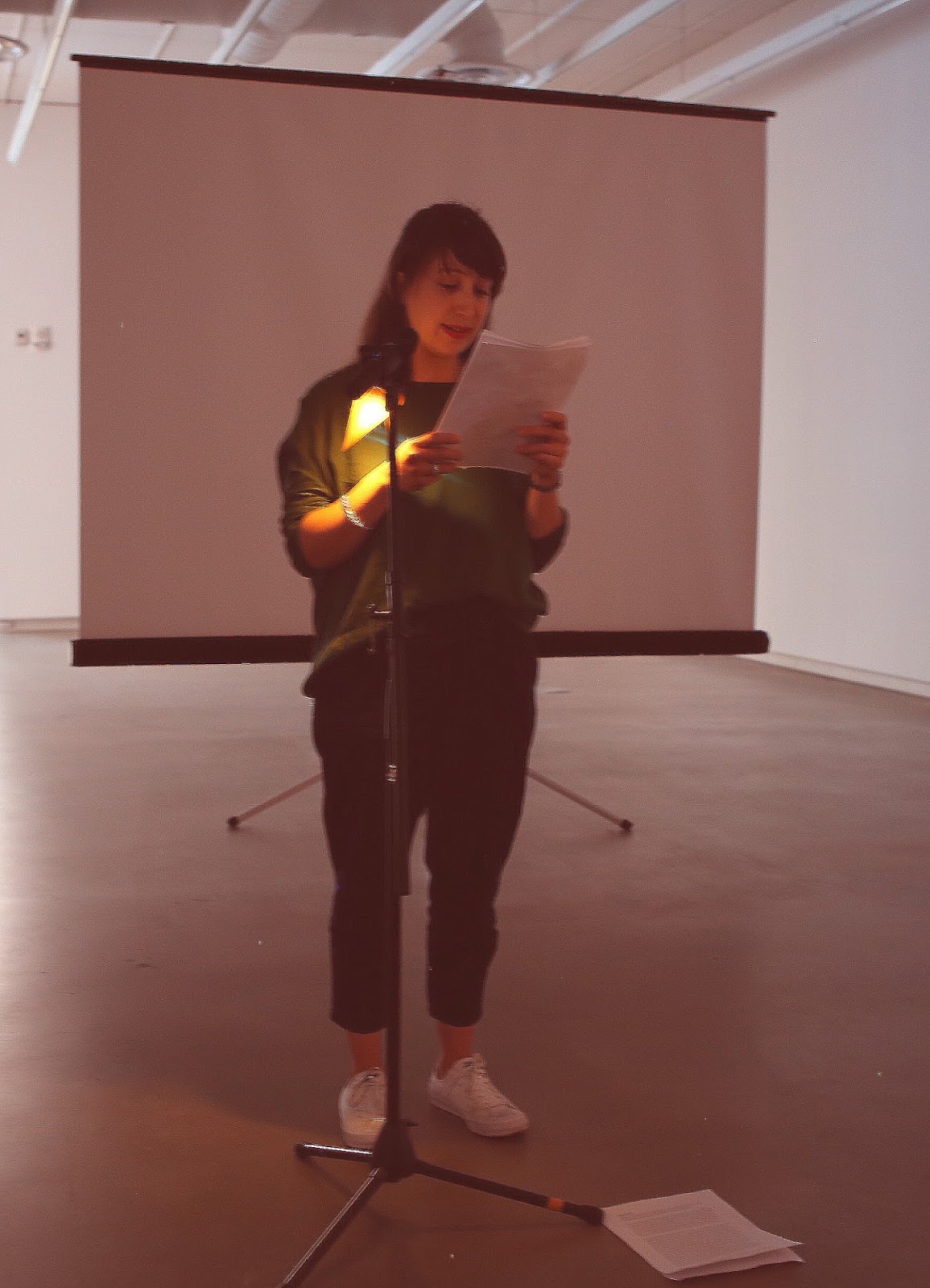
 Roewan Crowe reads from 'The Poetics of Here' with light source assistance from Plug In Director Jenifer Papararo


 Kegan McFadden reads an excerpt from 'When There is Nothing'


Esmé Hogeveen reads from her series of untitled fragments--notes for a novella

 
 Faith Wilson reads 'Butterfly Effect'


Jacquelyn Ross reads from 'The Case for Sentimentality'


 Fabiola Carranza reads from 'Restless Dog Near a Stream'


 Letch Kinloch reads from 'Dr. Dr.' to riotous laughter from the audience especially from Chloë Lum


Ralph Pritchard closes of the readings with his text 'Grotowski, Descenders, Shouldrs'


June 29, 2017

Final days of Group Workshops with Chris Kraus


Chris Kraus and Summer Institute participants engage in discussions on poetry and prose writings. Kraus led writing workshops whereby the Summer Institute participants share their individual works and receive feedback from peers as well as Kraus. Below are some images from the final days of their group workshops